
Best Emergency Backup Lighting for Homes: Comparing briteOwl®, Flashlights, Lanterns, and Other Options
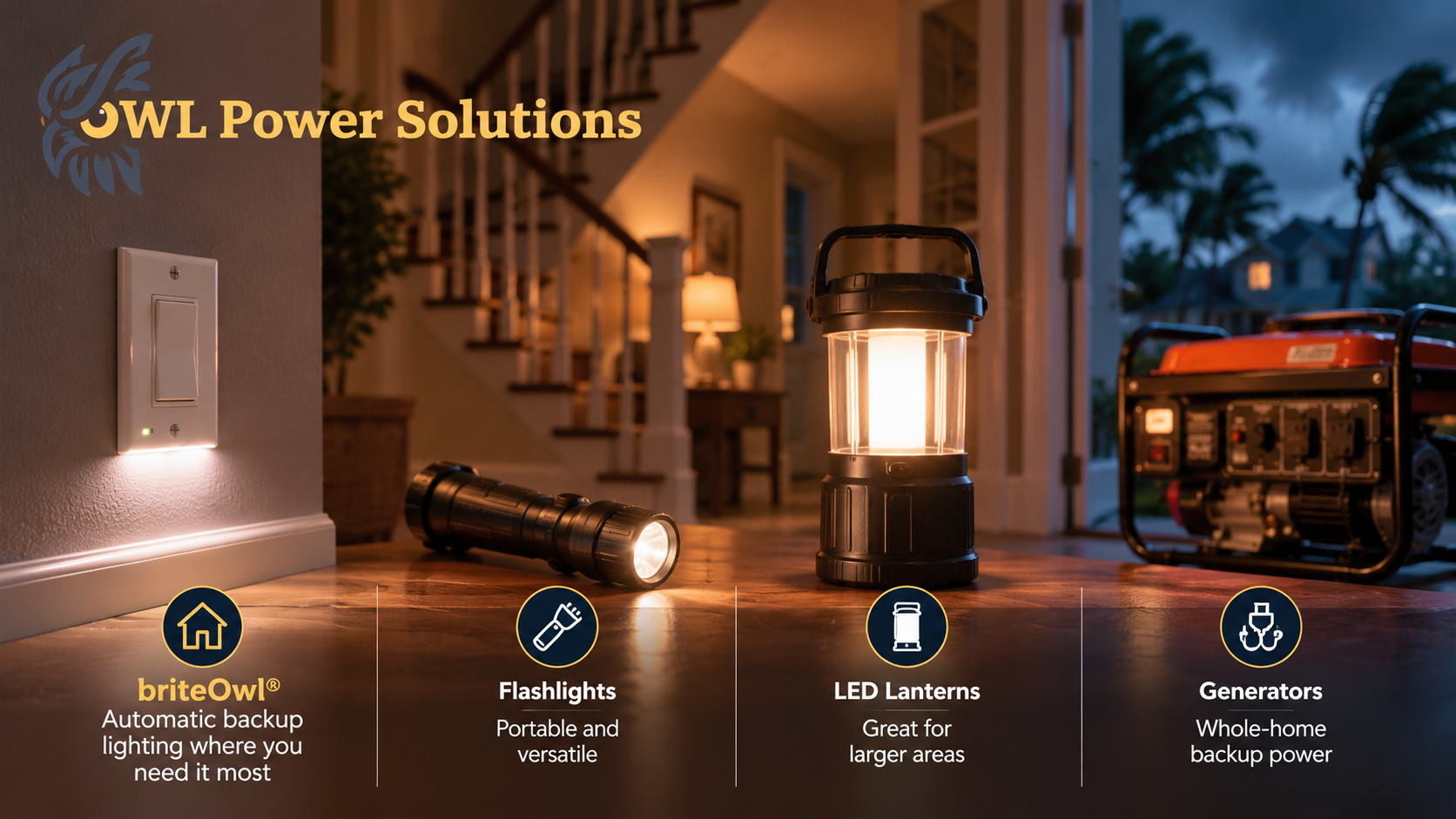
When the power goes out, having reliable lighting can make a significant difference in how safely and comfortably your household manages the disruption.
But with so many emergency lighting options available, how do you know which solution is right for your home?
Traditional flashlights, rechargeable lanterns, plug-in emergency lights, and automatic backup lighting systems all serve important purposes. However, they differ in convenience, placement, portability, maintenance, and how quickly they provide illumination when electricity fails.
For homeowners looking to improve their emergency preparedness, understanding these differences is the first step toward choosing a dependable lighting solution.
In this guide, we’ll compare popular emergency lighting options, explain which features matter most, and explore where briteOwl® from Owl Power Solutions fits into a complete home backup lighting strategy.
What Is the Best Emergency Lighting for a Home?
The best emergency lighting solution depends on how and where you need illumination during a power outage.
For immediate, stationary lighting, automatic battery-backed emergency lights can be particularly useful because they activate when utility power is interrupted.
For portable lighting, rechargeable flashlights and LED lanterns are excellent choices.
For extended outages, households may benefit from combining several lighting solutions rather than relying on a single product.
The most effective home emergency lighting strategy typically includes automatic backup lighting in essential areas and portable lights for additional flexibility.
Emergency Lighting Comparison: Which Type Is Best?
Different lighting solutions provide different advantages.
| Lighting Type | Automatic During Outage? | Portable? | Primary Advantage | Main Limitation |
| briteOwl® outlet-mounted backup lighting | Designed for automatic backup illumination | Primarily stationary | Lighting positioned where needed | Battery runtime is finite |
| Traditional battery flashlight | Usually no | Yes | Portable, directional light | Must be located and activated |
| Rechargeable LED lantern | Usually no | Yes | Illuminates larger areas | Requires charging and setup |
| Plug-in emergency nightlight | Some models | Model-dependent | Convenient automatic illumination | Features and brightness vary |
| Generator-powered home lighting | Depends on system | No | Can support existing household lights | Higher cost, installation and maintenance requirements |
| Battery-powered motion light | Motion activated | Model-dependent | Hands-free activation with movement | May not activate until motion is detected |
Note: Features vary by manufacturer and model. Always review the specifications of the specific product you’re considering.
No single option is ideal for every situation.
A flashlight may be best when inspecting storm damage or looking inside a cabinet. A lantern may be better for illuminating a room during an extended outage.
But when the power fails unexpectedly at night, an automatic backup light already positioned in a hallway or bedroom offers a different advantage: immediate illumination without having to locate or operate a separate device.
Automatic Backup Lighting vs. Traditional Flashlights
Flashlights remain one of the most common emergency preparedness tools.
They’re affordable, portable, and useful in a wide variety of situations.
However, flashlights have one important limitation: someone needs to find and turn them on.
Imagine waking up at 2:00 a.m. during a power outage. Your bedroom is completely dark, the hallway lights aren’t working, and the flashlight is stored in a kitchen drawer.
Getting to that flashlight may require navigating through the house without adequate visibility.
Automatic emergency lighting addresses this challenge by providing illumination in predetermined locations when normal electrical power is interrupted.
Automatic Backup Lights vs. Flashlights
| Feature | Automatic Outlet-Mounted Backup Lighting | Traditional Flashlight |
| Response to power loss | Automatic on supported models | Manual |
| Location | Remains in a designated area | Can be stored or carried anywhere |
| Hands-free illumination | Yes | Depends on design |
| Battery management | Often rechargeable while plugged in | Disposable or rechargeable batteries |
| Best use | Hallways, bedrooms, stairways, exits | Portable tasks, inspections, outdoor use |
| Coverage | Fixed location | Wherever carried |
| Extended outage use | Limited by battery runtime | Batteries can be replaced or recharged, depending on model |
The takeaway: Automatic backup lighting and flashlights aren’t competing solutions as much as complementary ones.
For many households, having both creates a stronger emergency preparedness plan.
briteOwl® vs. Standard Plug-In Nightlights
Not all plug-in lights are designed for power outages.
Traditional nightlights typically rely on electricity from the wall outlet. When utility power disappears, the nightlight turns off.
Some rechargeable plug-in nightlights include battery backup functionality, allowing them to continue operating during an outage.
This distinction is important when choosing lighting for emergency preparedness.
Comparing Standard Nightlights and Battery-Backed Emergency Lights
| Feature | Standard Plug-In Nightlight | Battery-Backed Plug-In Light | briteOwl® |
| Normal electrical power required | Yes | For charging | For charging |
| Battery backup | Usually no | Yes | Yes |
| Illumination during an outage | No | Yes, on supported models | Designed for outage illumination |
| Outlet-mounted | Yes | Yes | Yes |
| Emergency preparedness purpose | Limited | Yes | Yes |
| Suitable for strategic home placement | Yes, while powered | Yes | Yes |
A traditional nightlight may be helpful for everyday nighttime visibility, but it shouldn’t automatically be considered an emergency backup lighting solution.
Homeowners should verify that a product includes a battery backup system and is specifically designed to operate when utility power is unavailable.
Emergency Lighting vs. Whole-Home Backup Power
Some homeowners rely on generators or battery backup power stations to keep their homes functioning during outages.
These systems can be extremely useful, especially during prolonged interruptions.
However, backup power and emergency lighting serve different purposes.
A generator or home battery system is designed to supply electricity to selected appliances, circuits, or potentially an entire home, depending on the equipment and installation.
Emergency lighting is designed specifically to provide illumination when normal lighting becomes unavailable.
| Consideration | Outlet-Mounted Emergency Lighting | Generator or Home Battery System |
| Primary purpose | Provide local illumination | Supply backup electrical power |
| Installation | Typically plugs into an existing outlet | Varies from portable to professionally installed |
| Power capacity | Limited to the light’s internal battery | May support multiple devices or circuits |
| Maintenance | Battery and product checks | System-specific maintenance |
| Coverage | Individual rooms or pathways | Selected circuits or larger portions of a home |
| Best application | Immediate backup visibility | Broader electrical backup needs |
These technologies can work together.
Even homes with generators may benefit from independent emergency lighting, particularly if backup power doesn’t activate immediately or only supports selected circuits.
What Features Matter Most When Choosing Emergency Backup Lighting?
When comparing emergency lighting products, price and brightness aren’t the only considerations.
Homeowners should also evaluate how reliably the light will function when an outage occurs.
1. Automatic Activation
One of the most useful features is the ability to respond automatically when normal electrical power is lost.
This is particularly valuable during nighttime outages, when occupants may be sleeping or moving through dark areas.
2. Battery Backup
A rechargeable internal battery can allow emergency lighting to operate independently of the electrical grid for a limited period.
Check the manufacturer’s stated runtime and any recommended battery maintenance requirements.
3. Convenient Placement
Emergency lighting is most useful when installed where people need it.
Hallways, bedrooms, stairways, kitchens, bathrooms, and exits are all locations worth considering.
4. Brightness and Coverage
A light designed to illuminate a hallway may not provide the same coverage as a larger lantern intended for an entire room.
Compare brightness specifications and consider the size and layout of the space.
5. Ease of Installation
Plug-in emergency lighting can be especially convenient for homeowners who want to improve preparedness without installing permanent fixtures or modifying household wiring.
6. Long-Term Readiness
Emergency lighting should be tested periodically to verify that it operates as expected.
Rechargeable batteries also have a limited service life, so follow the manufacturer’s guidance for testing and replacement.
Where Does briteOwl® Fit Into a Home Emergency Lighting Plan?
Owl Power Solutions developed briteOwl® around a straightforward concept: emergency backup lighting should be conveniently located and ready when normal electricity is interrupted.
Its outlet-mounted approach allows homeowners to incorporate backup lighting into essential areas without depending entirely on portable flashlights or lanterns.
Rather than viewing briteOwl® as a replacement for every other emergency lighting product, homeowners can use it as part of a layered preparedness strategy.
For example:
- Bedrooms and hallways: Outlet-mounted emergency lighting for immediate visibility.
- Kitchen and living areas: Portable lanterns for broader illumination during extended outages.
- Emergency supply kit: Flashlights with spare batteries or a charging plan.
- Extended outages: A properly sized backup power source, when appropriate.
This combination addresses different needs while reducing reliance on any single lighting solution.
How Many Emergency Lights Does a Home Need?
There is no universal number of emergency lights required for every residence.
A home’s layout, number of floors, stairways, occupants, and available natural light all influence how much backup illumination may be appropriate.
A useful starting point is to identify the routes family members would need to travel during a nighttime outage.
Consider the path from each bedroom to the nearest bathroom, the route to the main exit, access to emergency supplies, and any stairways connecting different levels of the home.
A larger home with multiple floors may benefit from several strategically positioned lights, while a smaller single-story residence may need fewer.
The objective isn’t to illuminate every square foot of the home. It’s to make important pathways and frequently used spaces easier to navigate safely.
- Best Emergency Backup Lighting for Homes: Comparing briteOwl®, Flashlights, Lanterns, and Other Options - October 19, 2026
- After the Hurricane: Why Power Restoration Can Take Days—and How to Stay Safe in the Meantime - October 19, 2026
- Emergency Backup Lighting Explained: Why Every Home Needs Reliable Lighting During Power Outages - October 2, 2026